

The biographical film about “The King of Pop” Michael Jackson chooses to celebrate his glory rather than confront his shadows, creating an experience that is both captivating and poignant.
In the wave of musical biopics returning strongly after the success of works like Bohemian Rhapsody and Elvis, Michael carries special expectations. Not only because it is the story of a legend, but also because Michael Jackson is a figure almost impossible to “capture” in film: a genius, a cultural icon, and the focal point of countless controversies spanning decades.
Michael follows the journey of the famous singer from his days as a young boy in the Jackson 5 family, to stepping out of the shadow of his strict father to become “The King of Pop”. The film traces the key milestones: early performances, the turning point with the album Off the Wall, the global peak with Thriller, and the spectacular tours that propelled Michael Jackson’s name to worldwide fame.
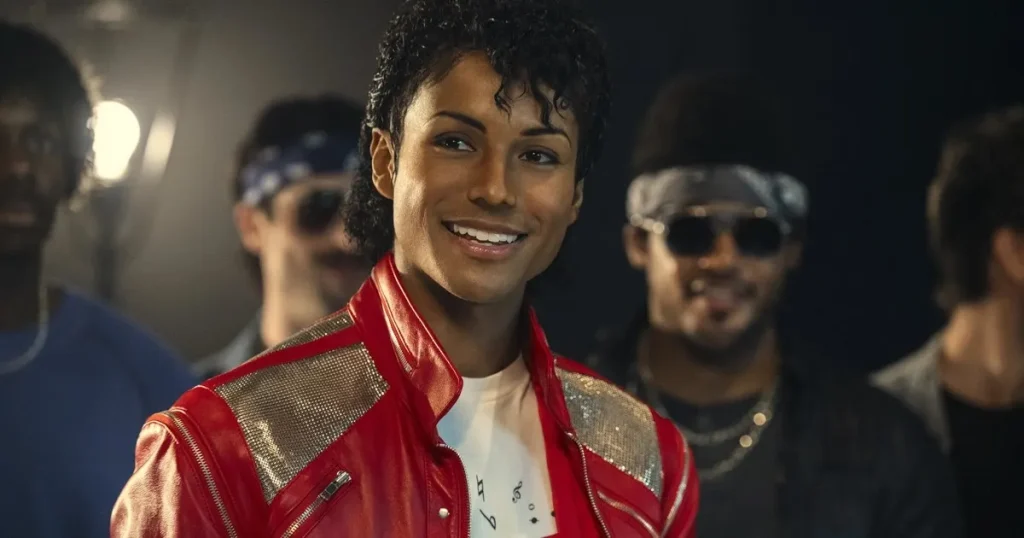
A Legend Reborn in a New Form
Director Antoine Fuqua seems to understand the “risk” of this subject matter and chose a safer approach, recounting the journey of a legend in the most beautiful and brilliant way possible. But it is precisely this choice that makes Michael a film that is both emotionally captivating and prompts viewers to question what has been left behind.
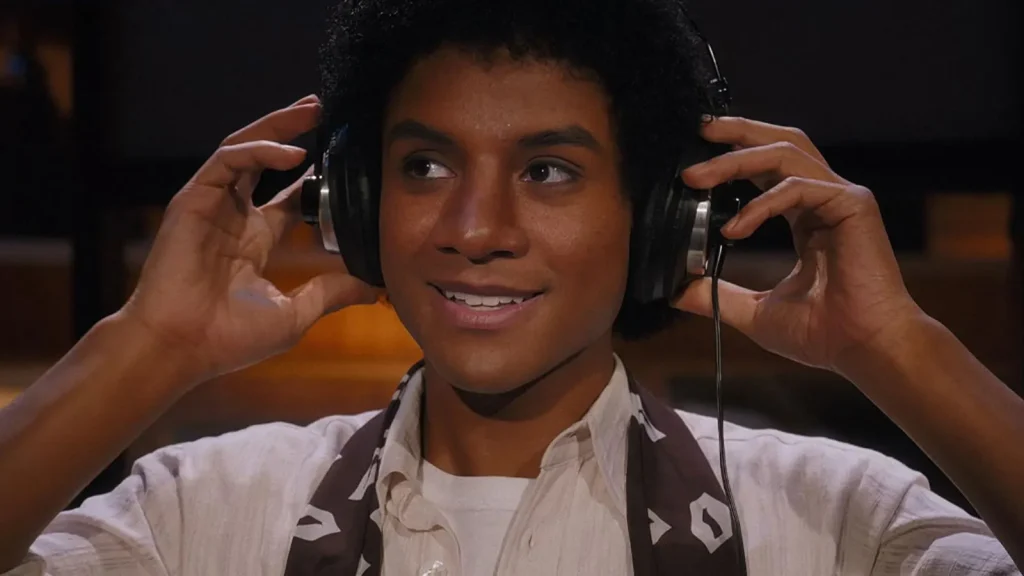
It’s no exaggeration to say that Jaafar Jackson – the grandson of the late legend – is the biggest reason audiences flock to theaters. From the very first frames, the resemblance between him and Michael Jackson creates a powerful visual effect: from his face and eyes to his body language, everything feels incredibly familiar.
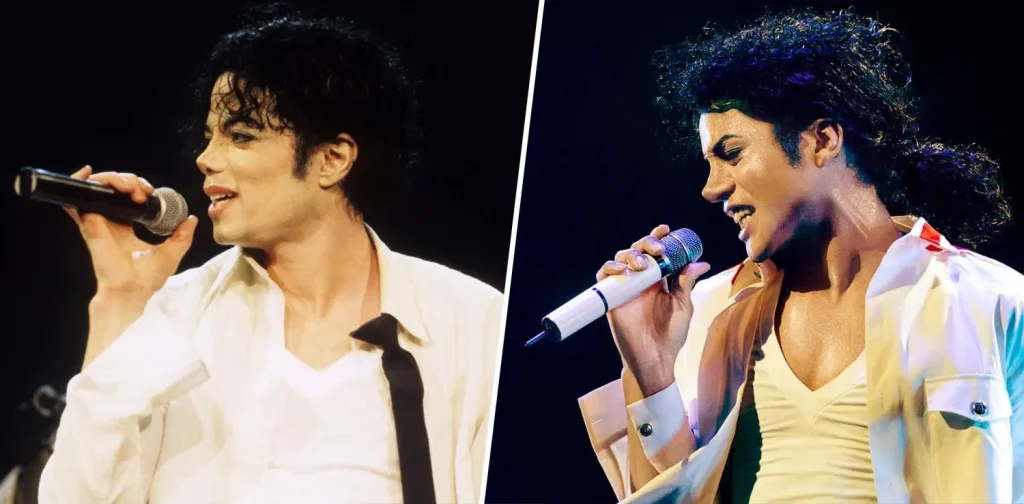
In the segment recreating the Motown 25 stage performance, where Michael first performed his iconic moonwalk in public, Jaafar not only “imitated” but recreated the explosive energy of this historic moment. The way he maintained his rhythm before sliding, his fleeting glance at the audience, and the burst of cheers all created a segment that was both nostalgic and vivid.
Similarly, in the Billie Jean performance, every step, every emphasis on the beat, and every pause before movement were handled with meticulous precision, as if Michael were vividly present before the audience.
Instead of a tightly woven linear narrative, the film chooses a structure that intertwines memories, piecing together fragments of life and stage, like a videotape of his career rather than a journey with a clear beginning and end.
However, when he steps away from the spotlight, the character lacks corresponding inner depth. Moments that should have delved deeply into the character’s psychology, such as family pressure and the isolation brought about by fame, are glossed over rather quickly. This leaves Jaafar, despite his efforts, confined to the framework of a character rather than a person with clear internal conflicts.
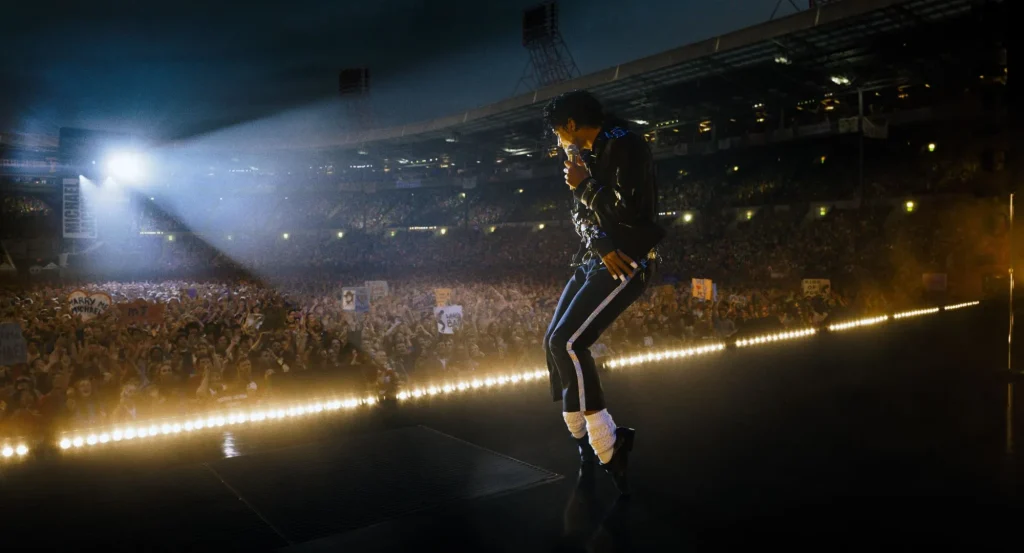
An Overwhelming “Cinematic Concert” Experience
If one expects Michael to be a narrative film, perhaps the work is not entirely complete. But if viewed as a concert elevated by cinematic language, the film is extremely effective.
The performance segments are staged on a grand scale, from the setting and choreography to the lighting. In the Thriller sequence, the film not only recreates the classic music video but also expands the space, transporting viewers into a semi-surreal world where the boundaries between stage and film are blurred. The camera revolves around the character, capturing every movement, while simultaneously creating an immersive feeling, as if the audience is standing in the middle of a crowd.
Another example is the tour segments, where the sound is treated to be thick and deep, recreating the “overwhelming” feeling of tens of thousands of spectators cheering together. Fast-paced cuts, alternating between close-ups and wide shots, help maintain a high tempo and sustained energy.
This vividly visual approach makes Michael accessible to a wide audience. Even those not particularly interested in Michael Jackson’s biography can be drawn into the visual and musical experience.
However, the price is a narrowed narrative. When each milestone only exists to lead to a larger performance, the film gradually loses its sense of development. Events are not structured as turning points, but rather as brief pauses before the spotlight shines again.
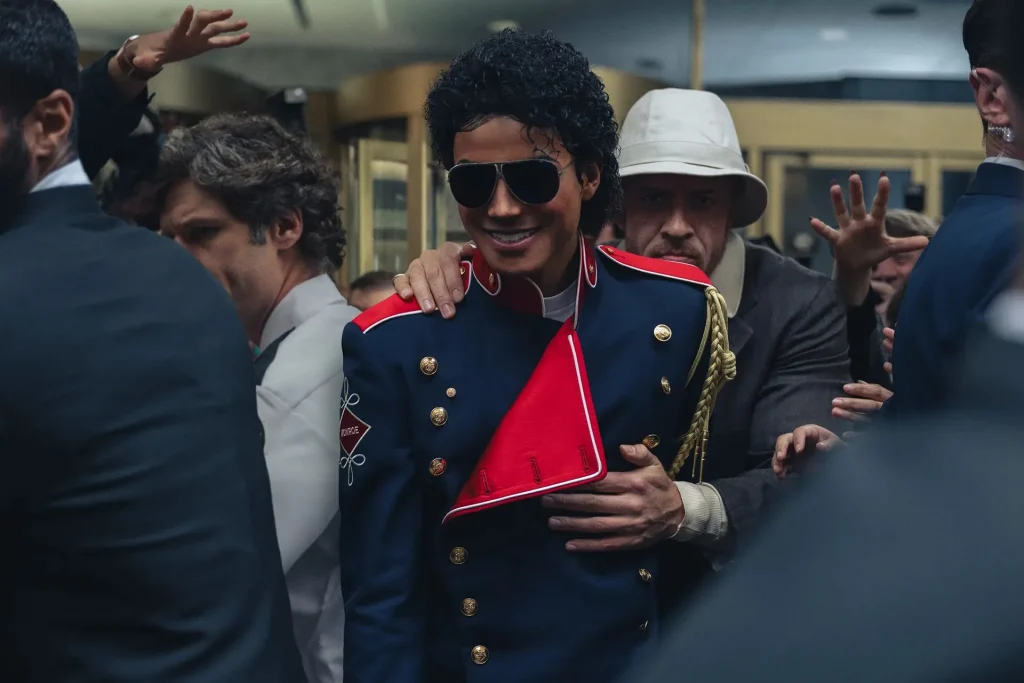
A “Glossed-Over” Portrait
The most controversial aspect of Michael lies in the film’s near-complete elimination of the darker aspects of the character’s life. The major controversies and scandals that once tarnished Michael Jackson’s image are absent from the film, or only mentioned indirectly and subtly.
Instead, the film focuses on his peak period, where Michael is portrayed as a lonely genius, misunderstood but always living for his art. This approach helps the film maintain its “beauty,” but at the same time, it loses the complexity—a crucial element in a biopic.
As a result, the narrative structure becomes disjointed. The film moves quickly through the stages, from childhood to the peak of his career, without dedicating enough time to delve into any conflicts. Some events only appear in a few brief scenes, then are quickly replaced by a new performance segment.
For example, family tensions or the pressures of fame, which could have been the main emotional focus, only serve as background. This leaves the character’s journey lacking emphasis and a strong enough climax to linger after the film ends.
Final Verdict on Michael (2026)
Michael (2026) is an emotionally rich experience, especially for those who love music and the legacy of Michael Jackson. The film scores points thanks to Jaafar Jackson’s impressive portrayal and the elaborately staged performances, giving the feeling of attending a real concert.
But when the lights go out, what remains is not quite a complete portrait. Michael is beautiful and captivating, but also so safe that it lacks the necessary sharp edges. And with a legend like Michael Jackson, perhaps just the spotlight alone isn’t enough to tell the whole story.
